UN Urges Australia To End LGBTQIA+ Discrimination By Religious Schools

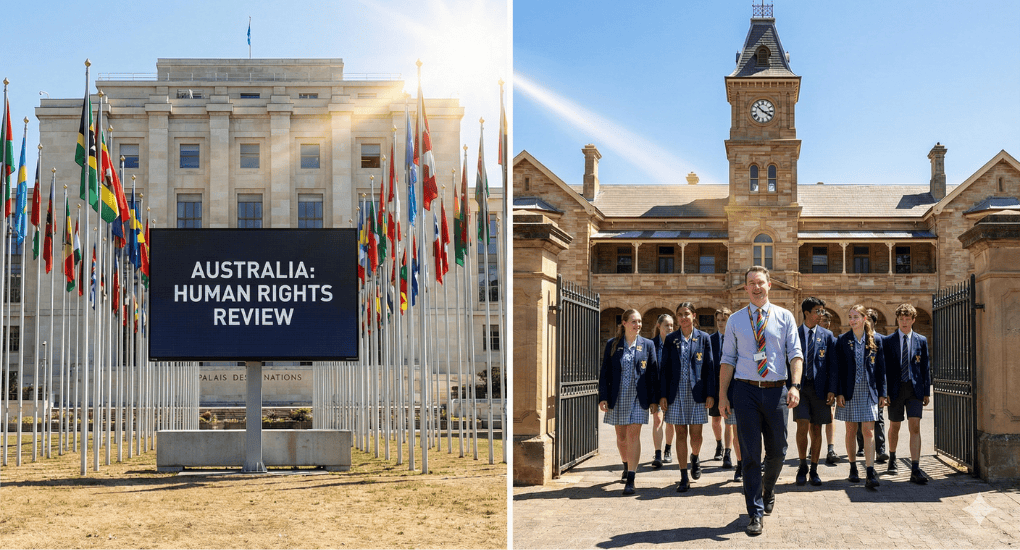
A United Nations review has formally called on the Australian government to scrap laws that allow religious schools to discriminate against LGBTQIA+ students and staff legally. Member states at the UN Human Rights Council in Geneva delivered the recommendation on Monday as part of the Universal Periodic Review (UPR).
This process is a comprehensive peer review of each UN member state’s human rights record that takes place every four and a half years.
The world is watching.
As part of Australia’s fourth UPR, more than 120 countries delivered around 350 recommendations to improve the country’s human rights protections. Nations including Belgium, Iceland, and Mexico specifically recommended removing the exemptions in the federal Sex Discrimination Act 1984.
These exemptions currently allow religious educational institutions to legally discriminate based on sexual orientation, gender identity, and sex, as well as marital or relationship status and pregnancy.
Public funding for private bias.
Equality Australia Legal Director Heather Corkhill highlighted the disparity between public support and private exclusion.
“Despite receiving millions in public funding, these schools are legally empowered to discriminate,” she said. “They can sack gay or trans teachers, deny promotions to unwed mothers or divorcees, and prevent LGBTQIA+ students from enrolling or taking on leadership roles.”
Current data indicates that one in three students and almost two in five staff are enrolled or employed in private schools, most of which are religiously affiliated.
Falling behind global standards.
International Advisor Savanh Tanhchareun stated that Australia was out of step with international law and practice, and out of touch with the expectations of everyday Australians.
“It’s embarrassing to see Australia falling behind other countries that view protecting staff and students in religious institutions as a basic human right,” he said.
“I know that many people are shocked to discover that religious schools can fire teachers for getting divorced and suspend students who come out as gay or trans. We want to believe that Australia values fairness and equality, but on the global stage our laws are painting a very different picture.”
A history of delayed action.
Labor committed to removing the SDA exemptions ahead of the 2022 election, but shelved a draft bill years later when it failed to get the backing of the Coalition. This inaction persists despite a 2024 Australian Law Reform Commission report finding strong public support, including among parents and people of faith, for removing the exemptions.
“The recommendations made to Australia by our fellow UN member countries are a wake-up call that these reforms are long overdue,” Mr Tanhchareun said. “These exemptions are cruel, outdated and indefensible, exposing thousands of Australians to punishment at school or dismissal at work simply for being themselves.”
Broader calls for change.
Other LGBTQIA+ specific recommendations included public education campaigns to address stigma, a national ban on conversion practices, banning medically unnecessary surgeries on intersex people, and more general recommendations about protecting our communities from discrimination and violence.
Equality Australia was part of a coalition of over 100 non-government organisations, experts, and community groups from across Australia who contributed to the UPR NGO Coalition Report. It provided recommendations to the UN to help improve the human rights of all people in Australia, including Aboriginal and Torres Strait Islander Peoples, people with disability, women, culturally and linguistically diverse communities, LGBTQIA+ people, and those living in regional and remote areas.
As part of the review process, the Australian government was also called on to address hate crimes and adopt a national Human Rights Act. A minimal age for criminal responsibility was also widely recommended.
Equality Australia is asking our community to share their experiences with discrimination in religious and private schools.
You can contribute to the survey at the link HERE.



