
Why Did It Take A Two Year Fight To Prove Gay People Have Rights To Free Speech?

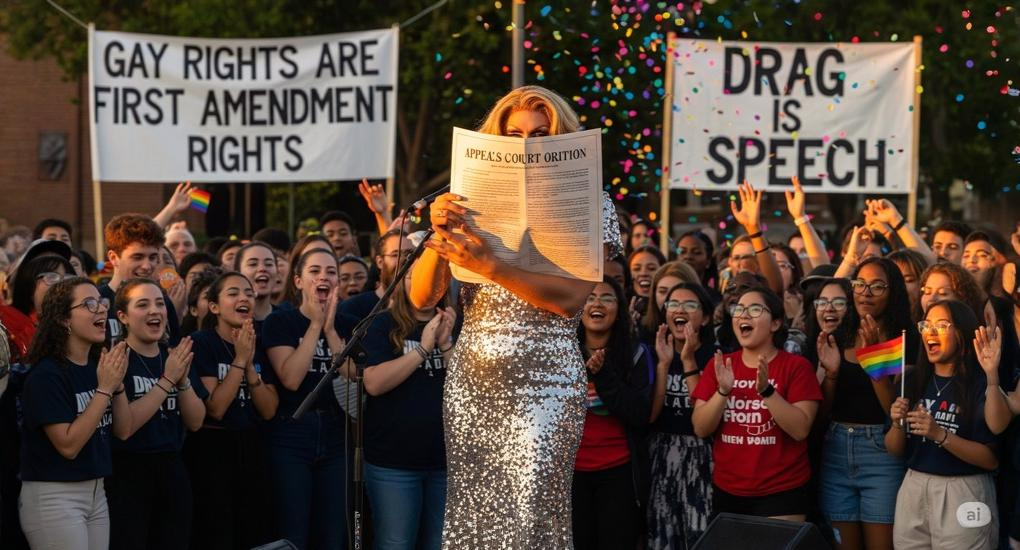
A US federal court has finally confirmed that banning drag shows is unconstitutional. The decision in the Spectrum WT v. Wendler case is a win for free speech. The problem is, it took more than two years for the courts to state the obvious, leaving performers and students in limbo. As detailed in an analysis by Vox, this victory feels less like a celebration for those involved and more like a long, exhausted sigh of relief.

So what was the holdup?
The whole situation started when Walter Wendler, the president of West Texas A&M University, decided to cancel a student-organised charity drag show on campus. He claimed drag was misogynistic and degrading to women. The student group, Spectrum WT, filed a lawsuit, arguing the ban violated their First Amendment rights to free expression. Simple enough, right?
Unfortunately, the case first landed on the desk of Judge Matthew Kacsmaryk, a man with a well-documented history of hostility towards LGBTQIA+ people. He allowed the university’s ban to stand. The student group appealed, but both the appeals court and the Supreme Court rejected requests to speed up the case or temporarily block the ban. For nearly two years, a judge’s personal prejudice effectively silenced student expression.
The ridiculous argument used to ban drag.
In his defence, President Wendler compared drag performances to blackface, arguing that just as he would not allow racist performances, he could not allow ones that he believed denigrated women. It is a weak argument for a few reasons. First, drag and blackface have entirely different cultural histories and purposes. Drag often critiques gender roles rather than attacking an entire group of people.
More importantly, from a legal standpoint, it does not matter. The First Amendment of the US Constitution protects almost all speech, even speech that is considered offensive. As the Supreme Court has ruled in other cases, hateful slurs and deeply offensive protests are protected forms of expression. So even if Wendler’s comparison were accurate, his legal argument would still fall flat.
Justice delayed is justice denied…
This was never just a theoretical legal battle. While the courts slowly processed the paperwork, a generation of students saw their university lives pass by. Roughly half of the undergraduate students who were there when the ban was imposed have since completed their degrees. They permanently lost the chance to organise their event, to perform, or to even attend the show during their final years at university. The court’s final ruling cannot give them back that experience.
A win is a win but the fight is not over.
While the appeals court made the right call, it was not unanimous. One judge, James Ho, dissented, siding with the university president. His opinion signals a continuing threat, showing that some in power are still willing to twist legal logic to target our community. At DNA, we know that this victory is important, but it also serves as a reminder. While this specific ban was overturned, the two-year delay proves that the system can be weaponised to deny rights, even if only temporarily.
Read the full story at Vox.
