
Opinion: Why Mitch Brown Is DNA’s Man Of The Year

PHOTOGRAPHY: Christian Scott | Instagram
He may be “here for the fun”, but Mitch Brown matters.
I’ve been waiting a long time for Mitch Brown. Decades actually.
The question, “Why aren’t there any out AFL players?” has been discussed among gay and sporting circles for a very long time.
To me, the answer was obvious – because the first out gay player would always be remembered as “the gay AFL player” rather than “the great goal-kicking AFL player” or “the great AFL captain”. And AFL players are usually young men who are not ready or equipped to become the spokesperson on all things LGBTQIA+; young men who are still dealing with their own sense of self, still finding out who they are.

Who would want the pressure of being a “role model” or a figurehead at 22 – especially if it involved something deeply personal, like sexuality?
And then there’d be the supporters. Imagine running onto the field for the first time as an out gay AFL player. There would be cheers from some quarters, but there’d be a lot of boos, too, hate and vilification from the stands, and trolling and death threats via social media.
How do we know this? Because we have the example set by racism. I remember when St Kilda player Nicky Winmar lifted his shirt, pointed to his skin and shouted, “I’m black and I’m proud to be black,” when spectators hurled racial abuse at him.
I remember when Adam Goodes took a stand against being racially abused, which only prompted more abuse. Goodes had won the Brownlow Medal twice and been Australian Of The Year – and was still racially abused while playing football.
I remember when English soccer fans threw bananas at black players. And I remember the story of Justin Fashanu, an English footballer who came out during his professional career and later died by suicide.
The pressure on the first, or any, openly gay AFL player would be immense if they were still playing professionally. My advice to people who want to come out is always to make sure it is safe to do so. For most male players in the AFL at this time, it would not be safe to come out.
But what I don’t understand is why more retired players haven’t come out. We know they exist. Let’s do some very rough maths: there are 18 players on the field and four on the bench; that’s 22 per team. There are currently 18 teams. That means there are at least 396 men playing in the AFL now – and a lot more if we include the VFL and WAFL and the squads as a whole, not just those who make it onto the team. Some of them will be gay or bisexual.
AFL has been played for over 128 years! (First in state-based leagues before becoming a national competition.) That means there have been, at the very least, over 50,000 men who have played Australian Rules Football professionally. If only one per cent of them were or are gay or bisexual, that’s still 500 men. Where are they?
If more AFL players are going to come out, there has to be a safe place for them to come out into, and that safe place could be created by the gay and bisexual players who are no longer competing. They still have influence within their clubs, but without the pressure of playing. These guys could help teach the AFL community about tolerance and acceptance and make life easier for those players who are not ready to come out.
So I always imagined the first out male AFL player would be someone who was no longer playing.
Mitch Brown arrives at Christian Scott’s studio for his DNA photo shoot and the first words out of my mouth are, “Oh, my God, you’re huge!” Followed by hello, pleased to meet you, etc. Mitch is big! And I realise in a flash that very few of the clothes we have for him are going to fit!

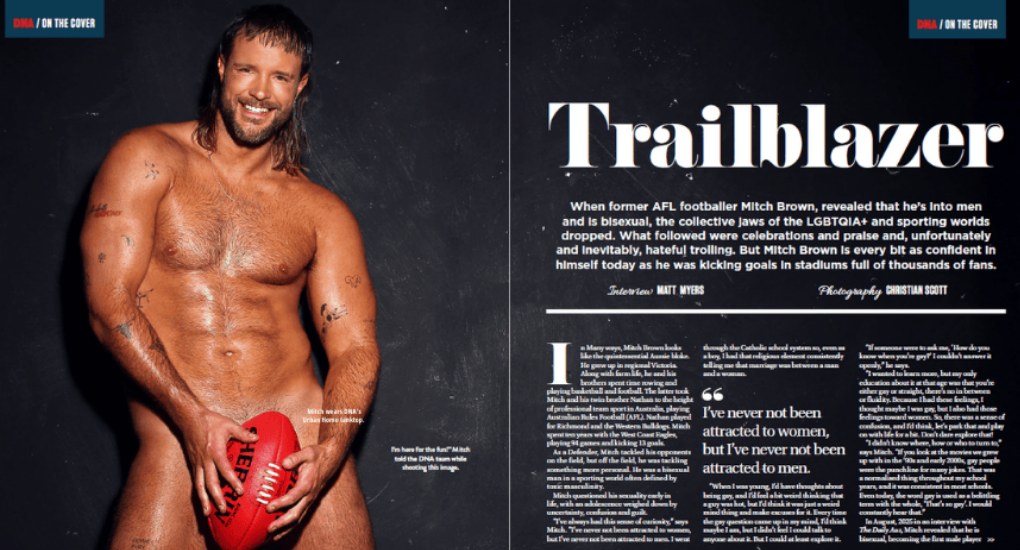
Mitch doesn’t seem to care! He insists on trying on some swimwear – that doesn’t even make it past his thigh let alone up to his waist. When I ask him to try on some DNA tank tops, he goes straight for the one that says Twink Bait. A cheeky grin lights up his face, and his partner, Lou, laughs, too. There’s obviously a story there, but they’re keeping it to themselves.
During the previous week, Mitch had found himself in a bit of a media whirlpool after commenting on a social media post by Geelong player, Bailey Smith. Having lost the Grand Final to the Brisbane Lions, Smith, and Geelong captain, Patrick Dangerfield, wearing cowboy hats, were photographed together in a pose that looked like a famous image from Brokeback Mountain and posted it with the caption: “This is what happens when you lose the granny.” The implication being that losing makes you gay, or that gays are not capable of winning.
It wasn’t hate-filled homophobia, and no doubt meant as a joke, but that kind of casual homophobia can be just as crushing, and Mitch posted a simple comment: “Do better.”
We texted about it; I told him I thought it was the right response. He replied, “It wasn’t just that post…” and added, “I’m known as the fun police now. Which is certainly not the case…”
With that in mind, I decided we’d make the DNA shoot as much fun as possible. Mitch is quick to laugh – he’s a warm-hearted larrikin – and he and Lou are on the same page. The fact that the underwear and swimwear are too small becomes hilarious as one garment after another goes into the too-small pile.
But none of that matters when we decide to try a nude shot. “I’m here for the fun,” says Mitch as he strips off completely and strategically positions a football over his junk. After a few shots, we ask him to hold the ball with just one hand. He obliges with a cheeky grin.
“I’m here for the fun,” says Mitch as he strips off and strategically positions a football over his junk.
When Christian gives the instruction, “Think of something that makes you really laugh,” Mitch has no problem, and a huge grin lights up his face.
Christian and I shot the boxer Harry Garside for DNA in the same studio, and it turns out that Mitch and Lou are friends of his. This doesn’t surprise me. They have similar values: treating people with respect, kindness, and pushing boundaries. They also share a haircut! It’s a blunt, straight fringe and mullet out the back.
Coincidentally, another famous mullet has its place in this story. In the 1980s, a Sydney Swans player, Warwick Capper, became the pin-up boy of the AFL. With his model good looks, short footy shorts, and blond mullet, he ended up on the cover of the gay magazine, Outrage. In part, my love of the gays, gay magazines, and the AFL goes all the way back to that Warwick Capper cover. Putting Mitch Brown and his mullet on the cover of DNA in 2025 feels like a full-circle moment.
Except this time, that AFL player is bisexual and out and ready to tell the world – a first in the AFL’s 128-year history. Perhaps Mitch is having too much fun to notice how significant this moment is for sport and the LGBTQIA+ world. It puts him up there among other sporting heroes like David Kopay, Ian Roberts, Billy Jean King, Martina Navratilova, Greg Louganis, Jason Collins, Orlando Cruz and Carl Nassib.
The AFL is big, old and slow, and will take years to change. Mitch Brown has given it a friendly boot up the backside to get things started.
Mitch is Man Of The Year because his simple authenticity will change things. By coming out, he has already changed things. There are young men whose opinion of their gay or bi teammates has changed. There are young men who will, perhaps, continue to play AFL, feeling less alone. And there are more AFL fans, Australians, and people around the world who no longer associate being gay or bi with shame. You don’t have to be straight to kick goals, to win, to be a hero.
Read Mitch Brown’s eight-page feature in DNA #311.

