
Karl Salsbury Wood Was Jailed For Being Gay But He Never Stopped Painting

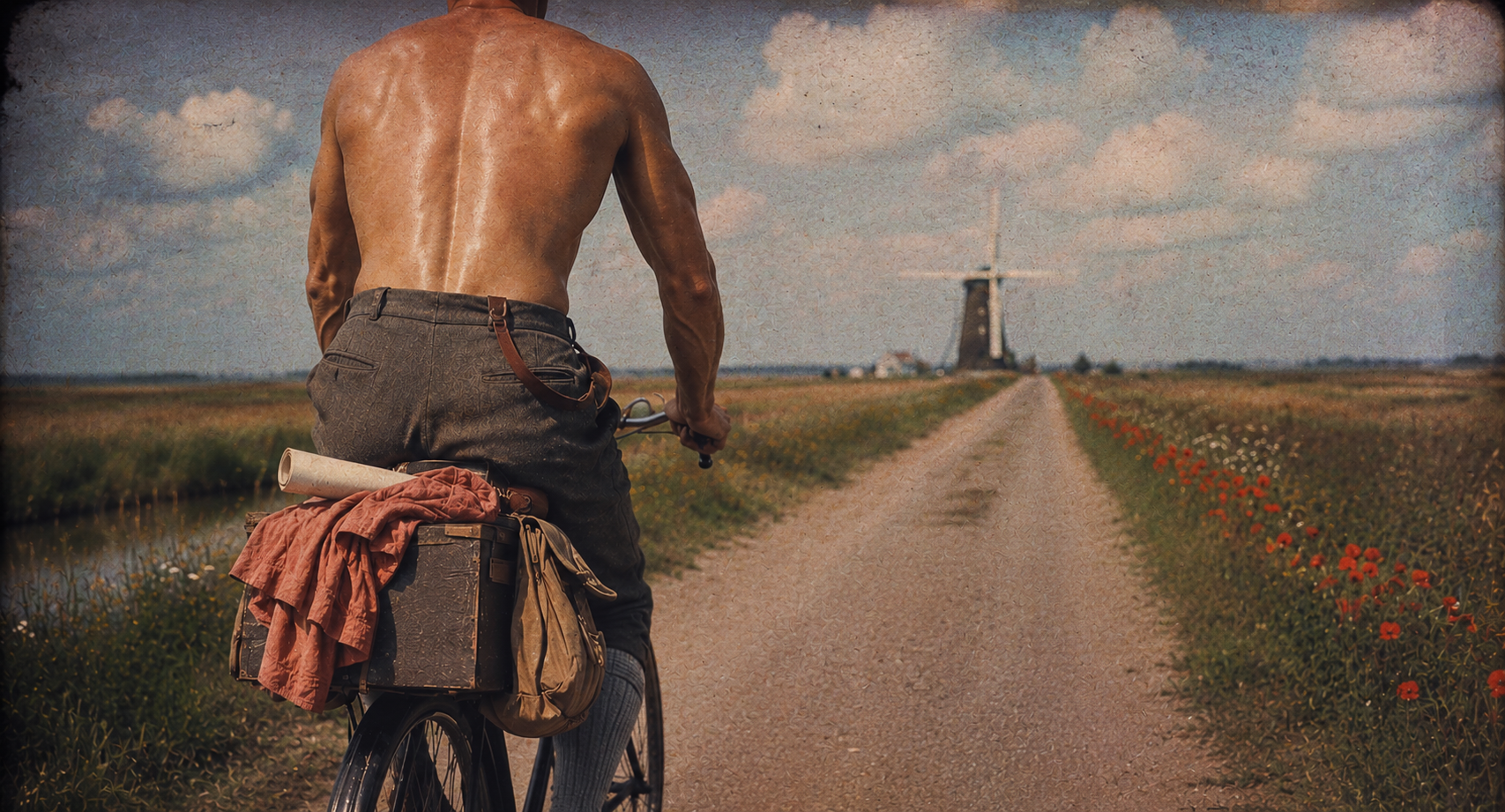
Karl Salsbury Wood painted 1,394 windmills. He did it while travelling around the UK by bicycle over nearly thirty years. In 1951, a court jailed him for four years for gross indecency. It was the same charge that took Oscar Wilde and Alan Turing. He never went home to Gainsborough again. He also never stopped painting.
A new exhibition in Sleaford has brought his story back. It runs across two sites and includes a new photographic commission and film by the artist Emily Andersen. She says Wood’s work had “been buried in a way” because of the conviction. Sharing it now, she says, is “vital”.
Wood was born in Derbyshire in August 1888. He joined the Third Seaforth Highlanders in 1914. Shrapnel caught his ankle in France. He limped for the rest of his life.
He moved to Gainsborough at the end of 1919 and stayed. He taught art and music from a studio on the Market Place. He sewed fancy dress costumes and hired them out. He was choirmaster and organist at the local Catholic church. He printed lino-cut greeting cards with his business partner, Laurence Wormell.
Andersen calls him “an eccentric”. He would “go around on a bicycle with his paints on the back of his bike”, she says. “He’d wear breeches and colourful shirts and dickie bows. He was somebody everyone knew.”
A bow tie. A bright shirt. A bicycle loaded with paints. In a Lincolnshire market town in the 1930s.
He was not hiding.
He Named His Life’s Work After Wagner
Wood loved Richard Wagner, so he took Götterdämmerung, the Twilight Of The Gods, and swapped in the German word for mills. Mühlendämmerung. In English, The Twilight Of The Mills. That was going to be the book. He named his route diaries after it too.
He reckoned about 1,650 windmills were still standing in Britain. He set out to paint every one before they fell down.
Sources put his first windmill somewhere between 1924 and 1928. The quest began properly around 1931. He was fast. By January 1933 a local paper reported he had cycled 28,000 miles and painted 450 mills.
Wood wrote his own column for the Gainsborough and Isle of Axholme News. In September 1932 he explained the bicycle. He had learnt “that unless one works for a thing it is scarcely worth the having”. It kept him fit. It got him places a car could not reach.
He called the mills “fast passing relics of the past”.
Andersen says he was “very, very fastidious about how he was making these trips and what he was doing it for”.
He Went To The Police Himself
Dr Tony Shaw’s biography records what happened next. Two men taunted Wood in the street on their way home from drinking. He had slept with one of them before. Frightened, Wood went to the police and told them everything.
He was charged with six counts of gross indecency involving three other men. All were adults.
The judge gave him four years. Shaw quotes the sentencing remarks. “I cannot find any excuse for a man of your education. It leaves me unmoved that you happen to be an artist and have done some good work which has earned the praise of others.”
Wood was 63.
The law was section 11 of the Criminal Law Amendment Act 1885. It never defined gross indecency. Spelling it out was considered indecent in itself. In practice it made any sexual contact between men a crime, anywhere, including at home. Lawyers called it the blackmailer’s charter.
Wilde got two years’ hard labour under it in 1895. Turing was convicted in 1952 and chemically castrated. Wood’s arrest came before Turing’s. His sentence was twice Wilde’s.
Wood was released in 1954. He could not face Gainsborough. So he took himself and every painting he owned to Pluscarden Priory near Elgin, in Scotland. He became an oblate [a person who gives their life to God and works with a religious group] and took the name Isadore. He kept working.
His last windmill painting shows a mill at Hopeman in Moray. He finished it on 21 May 1956.
Tuberculosis took him the following year. He died on 10 January 1958, aged 69. He is buried at the priory in a monk’s habit, under a plain wooden cross.
England and Wales decriminalised sex between men nine years later. Even then it applied only to men over 21, in private.
The book was never published. The quest was never finished. The painting carried on.
The Apologies Took 72 Years
Thousands of men were pardoned in 2017 under Turing’s Law. Lincolnshire Police apologised in 2023. Chief Constable Chris Haward said he was “sorry our LGBTQ+ communities have been disproportionately affected in this way”. He added that “there is no doubt this has damaged their trust in the police”.
Andersen puts it plainly. “It’s just the reality of what happened if you were homosexual,” she says. “I think we forget in 2026 in the West that it’s possible to be gay, homosexual, LGBTQ and so on. I think it reminds people of times when it was harder.”
Australia took just as long. South Australia decriminalised first, in 1975. Tasmania was last, in 1997. States only began letting men clear those records in 2013. Men are still alive here carrying a conviction for something that is not a crime.
Where To See The Work
Common Ground: Sleaford’s Shared Stories runs at The Hub and Sleaford Museum until 8 November. The Wood watercolours are on loan from Lincoln Museum. They have not been shown publicly since the 1970s.
The rest is scattered. Lincolnshire Museums holds the largest group, bought from Pluscarden in 1977. Gainsborough Heritage Centre has works the local civic society acquired after a 1973 exhibition. Cheltenham Art Gallery and Museum holds some. The Mills Archive keeps his pen and ink sketches.
Most of those 1,394 windmills are gone now. We know what they looked like because a man in a dickie bow got on a bike.

