
Botswana Repeals Anti-Sodomy Law – More Progressive Change For Africa

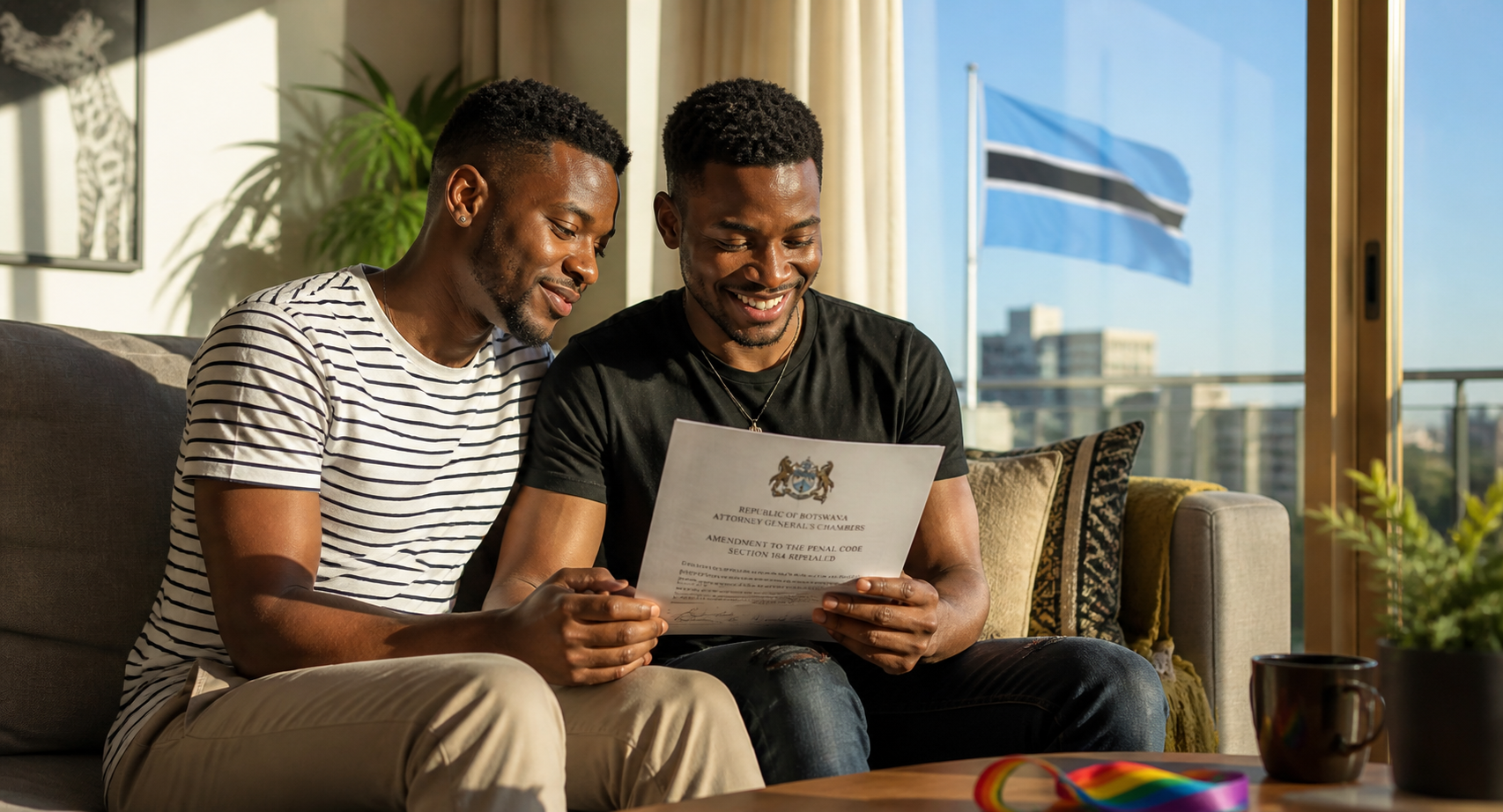
Botswana has formally repealed Section 164 of its Penal Code, the colonial-era law that made same-sex intimacy punishable by up to seven years in prison. Attorney General Dick Bayford published the amendment on 26 March 2026, finalising what the country’s High Court ruled unconstitutional in 2019. Botswana now joins a small group of African nations that have decriminalised consensual same-sex relations.
Of 54 African countries, more than 30 still criminalise same-sex intimacy. Most of those laws were imposed by British colonial authorities and have outlived their authors by more than a century.
What did Botswana’s law actually say?
Section 164 made it an offence to have “carnal knowledge of any person against the order of nature.” It carried up to seven years in prison. The law was a textbook colonial import, lifted almost word for word from a British template that criminalised same-sex intimacy across much of the former empire.
In practice, the law shaped daily life for queer people in Botswana even in periods when prosecutions were rare. People stayed careful at the doctor, guarded with employers, edited around their own families. The risk did not need to be high to be everywhere.
How did the repeal happen?
This was not a single moment. It was a seven-year legal grind.
In 2019, the High Court of Botswana ruled Section 164 unconstitutional. Judge Michael Leburu put it plainly: “Human dignity is harmed when minority groups are marginalised.”
The government appealed. It lost in 2021.
For the next five years, the law sat on the books with no force, an awkward contradiction nobody had bothered to clean up. On 26 March 2026, the Attorney General did. The same-sex provisions of Section 164 were officially deleted, leaving only the bestiality section intact.
What did LGBTQIA+ groups in Botswana say?
Local advocacy group LeGaBiBo (Lesbians, Gays and Bisexuals of Botswana) welcomed the change, saying it sends a clear signal that queer people in the country “are not criminals” and deserve protection.
That is not the same as full equality. Same-sex marriage remains unrecognised, and discrimination protections remain limited. Anti-LGBTQIA+ violence has continued, including the 2025 killing of Kenosi Mokobamotho, who was beaten, burned and left to die in a homophobic attack. Legal change does not erase social hostility on its own.
Why is this significant for Africa?
Because the direction of travel matters. In the past decade, Mozambique, Seychelles, Angola, Gabon and Mauritius have all decriminalised same-sex relations. South Africa has had constitutional protections since 1996. Botswana now joins that list in writing.
In the other direction, Uganda passed its Anti-Homosexuality Act in 2023, which includes the death penalty for so-called “aggravated homosexuality.” Ghana has been pushing similar legislation. Nigeria’s Same-Sex Marriage Prohibition Act remains on the books.
Two Africas are forming in queer law. Botswana has just stepped firmly into the half that is moving forward.
For us, that is good news worth sitting with.

