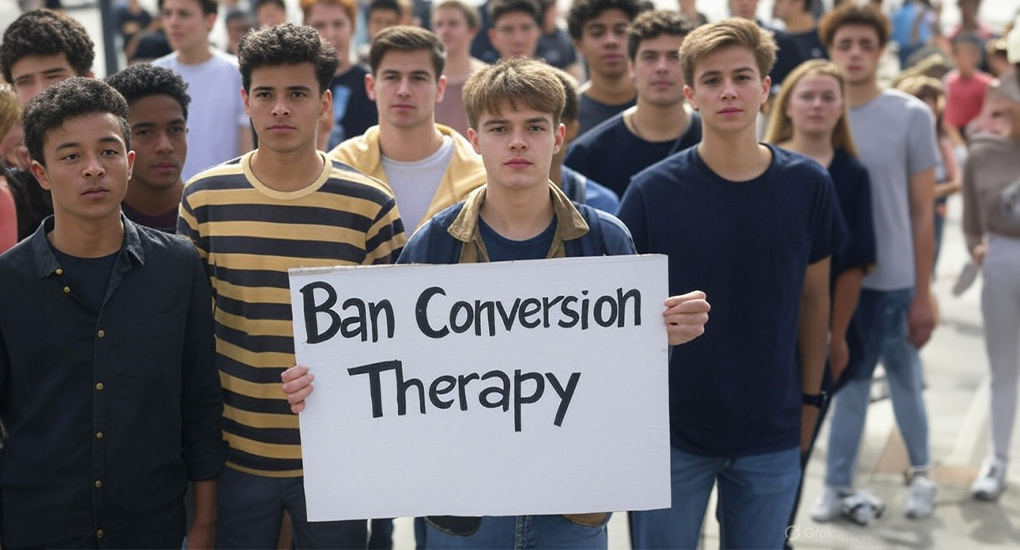
Legal Group Accused Of Twisting Research To Revive Conversion Therapy

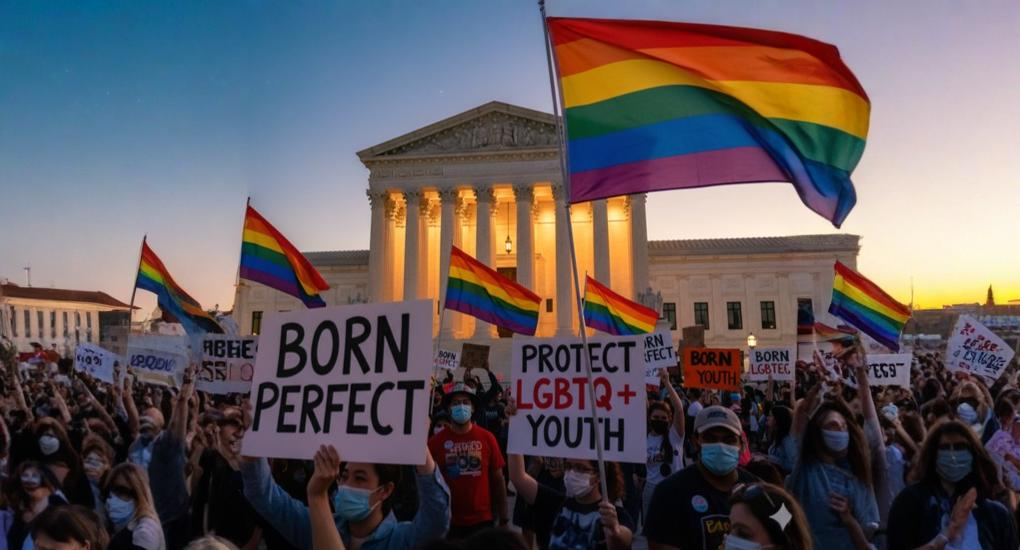
A Christian legal organisation faces serious accusations of misrepresenting academic research in its push to overturn conversion therapy bans. Scholars whose work was cited say their findings were distorted to support practices they explicitly condemn.
Alliance Defending Freedom (ADF) will argue before the US Supreme Court on Tuesday to strike down Colorado’s 2019 law prohibiting conversion practices for youth under 18. The case, Chiles v Salazar, could weaken protections for trans and queer young people across more than 20 states with similar bans.
However, two researchers quoted in ADF’s petition told The Guardian that the legal group “profoundly misrepresented” their work. A deceased researcher’s family says they’re “deeply disturbed” by how his statements were used.
When research gets twisted for the courtroom.
Clifford Rosky, a University of Utah professor of constitutional law, didn’t mince words about seeing his scholarship weaponised. “This is the most upsetting use of my scholarship that has ever happened in my career,” he said. “It’s upsetting because this is lethally dangerous to LGBTQIA+ kids.”
Rosky co-authored research with renowned sexuality researcher Dr Lisa Diamond. Their 2016 paper explored how some people’s attractions naturally shift over time. The key point? Civil rights should be protected whether sexuality is fixed or fluid.
ADF cherry-picked quotes suggesting sexual orientation can change. What they left out? The very same page condemns conversion therapy as “not only ineffective in changing sexual orientation but psychologically damaging, often resulting in elevated rates of depression, anxiety, and suicidality.”
How did lawyers justify selective quoting?
ADF excerpted a line stating “sexual orientation changes for many people” and referenced studies showing “changes in the same-sex attractions of some individuals over time.” Sounds reasonable until you read what came before: those studies specifically examined “change that occurs outside the context of [conversion therapy].”
“They are using our work to minimise the harm of conversion therapy,” Diamond explained. She’s a distinguished professor of psychology and gender studies. “There are few practices where there is as much demonstrated evidence of harm.”
The difference matters. Natural sexual fluidity isn’t the same as forcing someone to repress their identity. “It’s erasing the fact that conversion therapy is motivated by shame, fear of disconnection, fear of expulsion, fear of the loss of God’s love, fear of abandonment,” Diamond said. “Those are triggers of suicidality. That’s where the damage comes in.”
Rosky put it bluntly: “They claim our work supports conversion therapy when our work clearly and specifically condemns conversion therapy on the same page they’re citing.”
The case centres on a counsellor’s free speech claims.
Kaley Chiles, a licensed counsellor, argues Colorado’s ban infringes on her right to discuss Christian beliefs about “biological sex” with patients. ADF says she’s “begun censoring herself in conversations with clients” because of the law.
Colorado’s lawyers counter that Chiles manufactured the controversy. The state hasn’t received complaints about her or disciplined her. She filed a “pre-enforcement challenge” in 2022, three years after the ban passed. The law doesn’t apply to clinicians outside work or to religious ministers and life coaches.
ADF previously represented a Colorado web designer who won the right to refuse services to same-sex couples. The group petitioned the Supreme Court to hear Chiles’s case days after Donald Trump’s 2024 election victory.
What does the science actually say?
Conversion practices, sometimes called “reparative” therapy or “sexual orientation change efforts” (SOCE), range from religious counselling to outdated techniques like electrical shocks. Major medical organisations including the American Medical Association and American Psychological Association condemn these tactics. Research links them to increased depression and suicide attempts.
Rosky helped draft Utah’s 2023 conversion therapy ban. He pointed to studies finding 44% to 63% of youth who undergo these practices attempt suicide. “We’re not talking about suicidal ideation. We’re talking about actual attempts. By kids,” he said. “The stakes couldn’t be higher. It’s a grave public health threat.”
Diamond has spent years pushing back against misuse of her sexual fluidity research. She gave a 2018 TED talk about the very article ADF cited, spelling out why conversion practices cause harm.
“That’s what’s diabolical about them using me,” Diamond said. “They know they are misrepresenting my views. It also feels very hard to counter because it’s not coming from facts or reason. It’s coming from animus.”
Other citations raise eyebrows too.
ADF quoted Nicholas Cummings, who served as American Psychological Association president in 1979. The petition suggests he believed conversion practices worked, citing a 2013 op-ed about counselling patients from 1959 to 1979.
What ADF didn’t mention: Cummings endorsed the Trevor Project in 2015 and called efforts to “cure” gay people “unethical and a violation of human rights.” After his 2020 death, his family wrote an open letter stating he “strongly condemned all forms of conversion therapy” and his words had been “manipulated by those who support an anti-gay agenda.”
Asked about the Supreme Court citation, Cummings’s family said they’re “deeply disturbed by and we regret any distortion of Dr Cummings’ work for political purposes.”
ADF also cited a 2022 paper claiming conversion efforts don’t increase suicide. It was written by Rev D Paul Sullins, affiliated with the Ruth Institute, which defends “traditional Christian sexual ethics.” His paper used data from UCLA’s Williams Institute, a leading LGBTQIA+ policy research centre.
The Williams Institute reviewed Sullins’s work and called his conclusions “invalid” and “not supported by the data.” Their own 2020 study found sexual minorities exposed to conversion therapy “had nearly twice the odds of lifetime suicidal ideation.”
Ilan Meyer of the Williams Institute co-authored that research. “You don’t go with the one study that showed the opposite of what everybody else found,” he said. A Supreme Court brief noted 13 studies on conversion practices published since 2020. Sullins’s was the only one reporting positive impact.
ADF stands by its citations.
Jonathan Scruggs, ADF’s vice president of litigation strategy and senior counsel, didn’t address specific claims of misrepresentation. In a statement, he said: “We stand by what we quoted in the briefs as accurate quotations.”
He repeated that Chiles wants “voluntary conversations” with clients and there’s “no proof” those conversations would “cause any harm.” Scruggs added it’s “unfortunate that the state and certain ‘experts’ aligned with the state are trying to shut down conversations because they disagree with certain views.”
Diamond and Rosky filed a brief with the court “to correct the mischaracterisations of their research.” Neither scholar has been contacted by ADF.
What happens if the ban falls?
The Supreme Court’s conservative supermajority has ruled against LGBTQIA+ rights repeatedly in recent years. That includes upholding a state ban on trans youth healthcare and, in ADF’s 2023 case, ruling Colorado civil rights law violated the web designer’s free speech.
Curtis Lopez-Galloway founded the Conversion Therapy Survivor Network after enduring conversion practices at 16. “It would be absolutely catastrophic,” he said of a potential Chiles victory. He faces lifelong effects and hopes for a national ban similar to Canada’s, which broadly outlawed these practices for children and adults.
Cairn Journey Yakey, a non-binary Colorado licensed counsellor, filed an affidavit about the conversion practices they endured and the post-traumatic stress disorder it caused. “It was a big moment when Colorado passed this law,” they said. “We could take a deep breath because we took this step forward and collectively decided we can’t do this kind of harm.”
If the ban falls, Yakey expects renewed efforts to educate people about conversion tactics and support young people and survivors. The moment reminds them of when Maine repealed marriage equality in 2009 shortly after passing it. “That was my first time realising our rights are not static,” Yakey said. “So there’s familiarity in what I’m feeling now, but also shock and sadness and grief that this ban is being challenged.”