
The Whitsunday Islands And Airlie Beach – Adventure Islands

#sponsored
When thinking of crystal-clear oceans, blue skies and glorious white-sand beaches, you may also picture yourself reclining on a sunbed, enjoying a delicious cocktail and doing very little all day. And while all that is on offer during a visit to the Whitsunday Islands and Airlie Beach on the north coast of Queensland, the real appeal of the region is exploring its natural wonders. It’s all about the adventure.

There’s a lot to see and do, and many ways to experience it. From flying over the Great Barrier Reef – and maybe parachuting down to an island – to snorkelling over stunning coral outcrops and swimming among kaleidoscopes of tropical fish, or e-biking through lush tropical national parks.
The Whitsundays are a group of 74 islands off the central coast of Queensland, Australia, in the heart of the Great Barrier Reef. Geologically, they are referred to as continental islands because they were once connected to the mainland before the sea level rose at the end of the last ice age.
You’re probably already familiar with two of its main attractions: the much-photographed Heart Reef, a naturally formed 17-metre-wide heart-shaped coral outcrop within the Great Barrier Reef, and the white silica sands of the ever-changing Whitehaven Beach. Fun fact: the silica was formed during an earlier volcanic period, and it doesn’t absorb heat. So even during the hottest day of summer, you can walk barefoot across Whitehaven Beach.

Well-known Whitsunday Islands include Hayman Island, famous for its celebrity guests at the InterContinental Hayman Great Barrier Reef hotel, where per-night room rates start at around $700 and go up to around $2,000 for the luxury suites. And Hamilton Island, the largest inhabited island with its own airport, resorts, restaurants, and an 18-course golf course (par 71, if you’re interested).
However, for those interested in accessing all the region has to offer, the alternative to staying on one of the islands is to base yourself at Airlie Beach, on the mainland. This cute little enclave bustles with colour and a constant stream of international visitors from the UK and Ireland, Spain, Brazil, Germany and Japan, and many of the young people visiting the region also find work in the bars and cafés in the village. For our visit, we stayed at The Water’s Edge Resort, literally five minutes from the heart of the Airlie Beach main strip, and much better priced than the exorbitant room rates out on the islands.

With a choice of three pools and a hot tub, and stunning dusk and dawn views of the bay from our balcony, The Water’s Edge was a great base from which to sortie. Our apartment could’ve slept two adults in a master bedroom and three kids in a second, and came with a great kitchen and laundry and two bathrooms!
Refreshingly, most of our fellow travellers had not come to use the very Instagramable scenery as a selfie backdrop for their influencer accounts. Most were there to simply experience the beauty of the turquoise waters and explore the islands, coastlines and national parks without all the glitz and self-obsession of, say, the Gold Coast or Bondi.

I started my adventure holiday by taking a one-hour flight over the islands and out to the Great Barrier Reef. The Airvan plane on my trip held just seven passengers, which meant that everyone was guaranteed a window seat. Even better for me, I got to sit in the copilot’s seat up front. The views were amazing and, luckily, no actual co-piloting was required! We even circled Heart Reef twice to make sure people on both sides of the plane got the view and the shot.
The flying conditions could not have been better. The sky was clear blue, the islands and reef were easily visible, and a very light five-knot breeze meant virtually no turbulence or sudden drops, which can happen on light aircraft.

As part of the same tour, I transferred from the airfield to the marina to join an Ocean Rafting expedition. The craft was a 12-metre, rigid–hull inflatable, like a Zodiac but beefed up with a solid floor, shade, a toilet, and two massive Honda outboard motors at the back. These things really power across the open water and are highly manoeuvrable around the islands.
With my 30 or so fellow passengers, we left the marina and headed towards Whitsunday Island itself, and the famous Whitehaven Beach. It’s not just the fine silica beach sand and the water that make this beach so remarkable. Because of the ever-changing tides, sandbars and channels are constantly forming, being washed away and reforming. You’ll never see the same Whitehaven Beach twice. In some places, the water is shallow, and in others, the darker blue water indicates a deeper channel has formed. Sea turtles, dolphins, rays and reef sharks and lemon sharks (not dangerous to humans) are particularly drawn to the area.
Three lookouts are located on walking trails leading to the beach, and they offer superb opportunities for selfies and panorama shots.

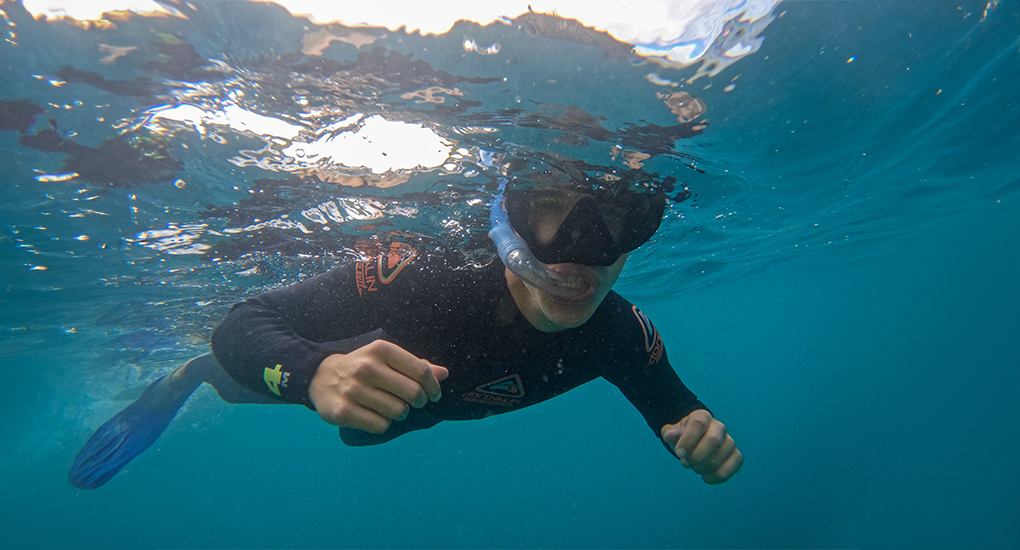
After lunch at Whitehaven, we piled back into the inflatable and headed to two snorkelling locations close to Whitsunday and Hook Islands. I was unaware that the coral reefs around the Whitsundays are as spectacular as those on the Great Barrier Reef. The diversity of shapes and colours of the coral was unexpected. At our second snorkelling location, it was the fish that were the star attractions. Again, the abundance of species, shapes, sizes and some truly mind-blowing colours took me by surprise. After a while, I stopped swimming over the reef and simply floated above it, allowing the fish to swim past me. Motionless in the water, they came up to investigate and soon I was shrouded in a cloud of tropical fish. Another memorable moment in a day that had already been full.
The islands were named by Captain James Cook during his first voyage in 1770. He sailed through the passage on what he believed was Whitsunday, the seventh Sunday after Easter in the Christian calendar. However, he got it wrong. Due to the fact that the International Date Line had not yet been established, Cook actually sailed through on a Monday. Oh well.

Of course, long before Cook, the islands were already home to the local Indigenous people. The Ngaro (pronounced nah-row) are one of the earliest recorded Indigenous groups on the east coast of Australia and have lived in the Whitsunday Islands and the surrounding mainland for at least 9,000 years. Sometimes referred to as the “saltwater people” their culture is deeply connected to the sea. They were expert navigators, fishers, and seafarers who moved between the islands and the coast in sewn bark canoes.
Hook Island (also known as Coonanglebah in Ngaro language) had one of the most reliable sources of fresh water of all the islands, and that made it a key site for both seasonal habitation and ceremonial activity. However, the Ngaro lived across multiple islands, including Whitsunday Island, South Molle, and Haslewood, as well as parts of the mainland (around present-day Airlie Beach and Shute Harbour).
Nara Inlet on Hook Island contains some of the most important archaeological evidence of Ngaro presence, including rock shelters, middens (piles of shellfish remains), ancient stone tools and rock art estimated to be thousands of years old, depicting clan symbols and other motifs. The Whitsundays has dozens of cultural sites, though many are unmarked or protected due to their sensitivity.
With European colonisation in the 1800s, the Ngaro, like many Indigenous peoples, were violently displaced from their lands. This included forced removals, massacres, relocation to missions and enslavement and forced labour in lumber mills.

By the early 20th Century, very few Ngaro people remained on their traditional lands, and much of their culture was suppressed or lost. However, there has been a renewed interest in reviving Ngaro culture and history in the Whitsundays. Some descendants are working to preserve their heritage through cultural education programs, tours, and signage at key sites. Many places retain Indigenous names or have been dual-named, and you’ll often see acknowledgements of Country at visitor centres and on guided tours.
When visiting the Whitsundays, remember that these islands are not just tourist destinations, but sacred Country with deep spiritual and historical significance to the Ngaro people.
For our second action-adventure day, we changed pace and swapped the ocean raft inflatable for the old-world elegance and romance of a wooden sailing ship.

The Providence V is a classic, gaff-rigged schooner. She’s actually a replica of the Grand Banks fishing boats that sailed the waters of Newfoundland, but was built using Queensland timber 30 years ago. She cut through the open waters gracefully with all the creeks and sighs that sailing ships make – a relief after the previous day’s noisy outboard motors!
Our captain was named, and I’m not making this up, Jack Savage, and his first mate was Hans, the deckhand. When I shared an image of them on social media, someone asked, “Are they famous?” They’re not, but they do look like they’ve stepped out of a classic movie or a streaming series: tanned, relaxed, enjoying life on the sea.
The Whitsundays are a world-renowned sailing destination. Visitors can charter yachts with or without a crew, but today we were happy to be part of a tour that took us back to Whitehaven Beach and, after lunch, to Dumbbell Island and reef for more snorkelling and even more spectacular fish and corals.

This outing was far more relaxed than the action-packed itinerary of the first day. Feeling the swell lifting and gently releasing the ship, the warm, early winter sunlight, the sound of the canvas sails catching the wind – well, it’s hard not to be entranced by the experience.
If a trip to the Whitsunday Islands is on your to-do list, peak season is generally June to October. This is the dry season, when temperatures are cooler, humidity is low, rainfall is limited, and it’s also the humpback whale migration season. It’s also advisable to go at this time because it’s not the stinger season! During the summer months, marine stingers like box jellyfish are present, and stinger suits are required for swimming. During peak season, most people swim without stinger suits, though they are offered by tour operators year-round.
November to May are the hot, humid months when the most dangerous stingers are present. Irukandji are tiny but highly venomous jellyfish, only about 1 to 2cm, and almost invisible in the water. Their sting can cause intense lower back pain, nausea and vomiting, muscle cramps, elevated heart rate and blood pressure. They live in deeper offshore waters but can be found inshore, particularly in calm, warm conditions. They don’t like the cooler water of the peak season.

Snorkelling, swimming and sailing, and being all-round action tourists, builds an appetite, and Airlie Beach has plenty to offer, from the meat-feat of KC’s Grill And Bar to the modern Australian sophistication of The Deck, there are plenty of choices across cuisines, price points, and locations. Breeze Bar does some wicked cocktails, and, for a small place, Airlie Beach also has at least three ice creameries that we found.
There’s not a hugely visible LGBTQIA+ presence in Airlie Beach. You won’t see rainbow flags fluttering outside businesses on the strip, but I did notice a few couples on my tours and wandering around the Airlie Beach village. My feeling is that “safe spaces” are not needed here. Everyone is welcome.
For Aussies in the south, the Whitsundays are the perfect winter escape. There are direct flights into Proserpine (Whitsunday Coast Airport) from Brisbane, Sydney, Melbourne, and Adelaide, and from there you can shuttle bus into the village. Alternatively, fly into Brisbane and transfer by light plane to Proserpine.
When packing, remember that while it may be freezing in your city, north Queensland’s average winter temperature is 17–26C (63–79F). Take multiple pairs of swimwear because a lot of your activities will happen in and around water, and pack your own snorkel, goggles and fins because even while your tour operators will supply those, there will be days where you want to explore on your own and splendid underwater sights are waiting to be seen just off the coast. Not an open water fan? Airlie Beach has a massive human-made lagoon – staffed by friendly and, yes, sexy, lifeguards!
Special Offer: Use the code DNA25 when booking and receive a 10% discount, a complimentary bottle of wine on check-in, and late check-out at Water’s Edge Resort, Heart Hotel and Gallery Whitsundays.
Go to At Water’s Edge Resort
Go to Heart Hotel and Gallery Whitsundays
For the Great Barrier Reef flight and Ocean Rafting, go to www.oceanrafting.com.au
For the Provenance sailing ship, go to https://sailing-whitsundays.com/whitsundays/providence-v
DNA stayed courtesy of At Water’s Edge Resort.



